Airport Car Service Terminology: A Traveler’s Guide


TL;DR:
- Understanding airport car service terminology helps travelers select the correct vehicle type, service style, and pickup method to avoid confusion and delays. Knowing key terms like “meet and greet,” “curbside pickup,” and “dispatched” ensures clear communication with drivers and efficient airport transfers. Regional vocabulary differences, such as “private hire vehicle” in the UK or “VTC” in France, reflect varying regulations and help travelers understand service standards across countries.
Airport car service terminology is the specialized vocabulary that defines vehicle types, service categories, and operational practices used in ground transportation at airports. Knowing these terms before you book prevents costly misunderstandings, from arriving at the wrong pickup zone to selecting the wrong vehicle class entirely. Whether you are arranging a luxury airport transfer in Miami or coordinating corporate ground transport at JFK, the words used in booking confirmations and driver communications carry precise meanings. This guide decodes the most important airport car service terms so you can communicate clearly, plan confidently, and travel without surprises.
What is airport car service terminology and why does it matter?
Airport car service terminology is the set of specific words and phrases that define how ground transportation services operate at airports. These terms cover vehicle categories, service styles, pickup procedures, and driver roles. Misreading even one term can send you to the wrong terminal curb or leave you waiting while your driver circles the cell phone lot.
The industry uses terms like limousine service, black car service, chauffeur service, and private hire vehicle to describe distinct offerings. Limousine, black car, and chauffeur services each carry distinctive meanings related to vehicle type, service style, and booking method. In New York City, for example, the Taxi and Limousine Commission defines black car service narrowly by licensing category, not just vehicle color or class.
Understanding this vocabulary also signals what regulatory framework governs your ride. A licensed chauffeur service operates under different rules than an on-demand rideshare, and those rules directly affect your safety, pricing, and accountability. Travelers who recognize these distinctions make faster, smarter booking decisions.
Common types of airport car services and their key terms
The most frequent service categories you will encounter when booking airport ground transport each carry a specific definition.
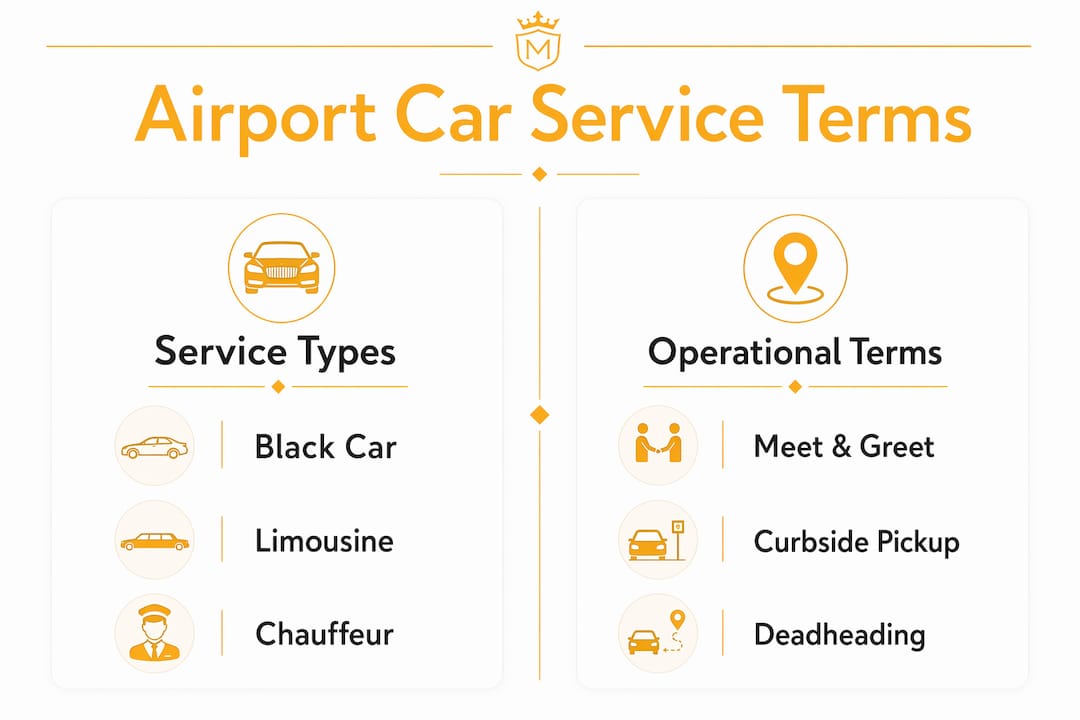
Black car service refers to a pre-booked, professionally driven vehicle, typically a dark-colored luxury sedan or SUV, operating under a commercial license. This term is most common in the United States, particularly in major cities like New York and Miami.
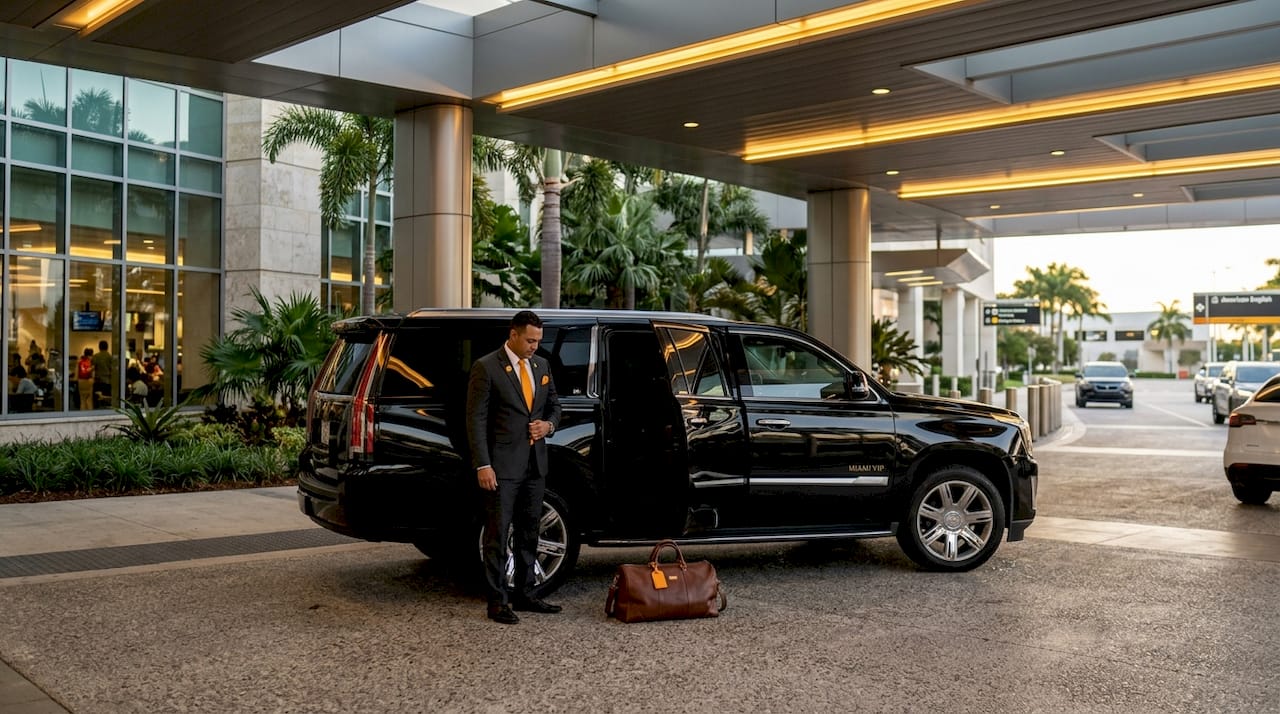
Limousine service implies a luxury vehicle, often a stretch limo or high-end sedan, with an emphasis on comfort and presentation. The term signals premium pricing and formal occasion transport more than it describes a specific vehicle shape.
Chauffeur service focuses on driver professionalism. A chauffeur is a trained, uniformed professional who handles luggage, opens doors, and maintains strict punctuality standards. The vehicle matters less than the service standard.
Point-to-point transfer means direct travel from one location to another without detours or multiple stops. This service type is standard in luxury airport transport because it eliminates the shared-ride delays common in shuttle services.
Pre-booked vs. on-demand transport is a critical distinction. Pre-booked services are reserved in advance with a confirmed vehicle, driver, and price. On-demand transport, like rideshare apps, dispatches the nearest available driver after you request. Airport car services are almost always pre-booked.
Vehicle class terms you will see in booking forms include sedan, executive sedan, SUV, luxury van, Mercedes-Benz Sprinter, and mini-coach. Luxury fleets include sedans, SUVs, limousines, and vans matched to passenger count and occasion. Booking a sedan for five passengers with luggage creates a problem that a Sprinter would solve instantly.
Pro Tip: Always confirm the exact vehicle model in your booking confirmation, not just the class label. “SUV” can mean anything from a Chevrolet Suburban to a Lincoln Navigator, and the difference matters for luggage capacity.
What operational terms do airport car services use?
Operational terms describe how a service is executed from dispatch to drop-off. These are the words your driver and dispatcher will use, and understanding them prevents confusion at the curb.
Meet and greet is a service where the driver meets you inside the terminal or at a specified location, holding a sign with your name. This differs from curbside pickup and typically includes luggage assistance. Meet and greet is the standard for VIP and executive airport transfers.
Curbside pickup means your driver pulls to the designated curb outside arrivals and waits briefly for you to exit the terminal. This is faster than meet and greet but requires you to be ready and moving when the vehicle arrives.
Cell phone waiting lot is a designated area at most major airports where drivers park at no charge while waiting for passengers to clear baggage claim. The driver moves to the curb only when you call or text to confirm you are ready. This system exists because curbside is for active passenger pickup only, not extended waiting.
Deadheading refers to a driver traveling to a pickup location without a passenger in the vehicle. This term matters for pricing because some services charge a deadhead fee when your pickup requires significant repositioning of the vehicle.
Dispatched means a driver has been officially assigned to your booking and is en route. When a service confirms your driver is “dispatched,” you should receive driver details including name, vehicle, and license plate.
Flight tracking is the practice where professional chauffeurs monitor real-time flight data to adjust pickup times based on early or late arrivals. This is a standard feature of professional airport car services and a key differentiator from rideshare apps, which require you to request a ride manually after landing.
White glove service describes the highest tier of personalized attention, including door-to-door luggage handling, premium vehicle amenities, and proactive communication throughout the journey.
“Airport curbsides are managed carefully to avoid congestion and unauthorized parking, making awareness of ‘active loading’ zones essential for travelers and drivers alike.” — San Francisco International Airport ground transportation guidelines
How airport-specific vocabulary affects your car service experience
Airports have their own vocabulary that directly intersects with car service logistics. Knowing this language helps you give accurate information when booking and avoids pickup failures.
Airport codes like JFK (John F. Kennedy International), MIA (Miami International), and SFO (San Francisco International) identify specific airports. Using correct airport codes ensures your driver is dispatched to the right location. Confusing MIA with FLL (Fort Lauderdale-Hollywood International) is a real and costly mistake for South Florida travelers.
Terminal refers to the specific building within an airport where your flight arrives or departs. Large airports like JFK have multiple terminals, and a driver waiting at Terminal 4 cannot reach you at Terminal 8 quickly. Always include your terminal number in your booking.
The table below summarizes the most important airport-specific terms and their practical impact on car service bookings.
| Term | Definition | Practical impact |
|---|---|---|
| Airport code | Three-letter IATA identifier (e.g., MIA, JFK) | Determines which airport your driver is dispatched to |
| Terminal | Specific building within an airport | Affects exact pickup location and driver positioning |
| Arrivals curb | Designated curbside lane for incoming passengers | Where curbside pickups occur; active loading only |
| Kiss & fly zone | Short-term drop-off area for departing passengers | Not for pickups; drivers cannot wait here |
| Cell phone lot | Free waiting area for drivers before passenger is ready | Reduces curb congestion; driver moves on your signal |
| Pickup zone | Designated area for licensed car service vehicles | Separate from rideshare and taxi zones at many airports |
At San Francisco International Airport, vehicles are not allowed to wait at terminal curbside. Parked or unattended vehicles receive fines, and passengers must be ready outside the terminal when the vehicle arrives. Miami International Airport operates similarly, with designated zones separating licensed car services from rideshare and taxi lanes.
How airport car service terms differ across regions
The same service described by different words in different countries creates real confusion for international travelers. Airport car service vocabulary often signals the market structure and regulatory framework behind each service type.
In England, the term private hire vehicle (PHV) covers minicabs, chauffeur cars, and limousines. PHVs must be pre-booked and cannot be hailed on the street, unlike licensed taxis. In France, the equivalent is VTC (Voiture de Tourisme avec Chauffeur), a regulated category of pre-booked private driver services. In the United States, black car service is the dominant term, though its legal definition varies by city.
| Region | Common term | Equivalent meaning | Key distinction |
|---|---|---|---|
| United States | Black car service | Pre-booked luxury vehicle with driver | Regulated by city TLC or state DMV |
| England | Private hire vehicle (PHV) | Pre-booked minicab or chauffeur car | Cannot be hailed; requires advance booking |
| France | VTC | Pre-booked private driver vehicle | Separate licensing from taxis |
| Australia | Hire car | Pre-booked private transport | Distinct from taxi and rideshare licensing |
The legal and licensing terms also vary. In the US, terms like TNC (Transportation Network Company) describe rideshare platforms like Uber and Lyft, while limousine carrier or black car base describes licensed luxury ground transport operators. Knowing which category your provider falls under tells you what insurance, background check standards, and pricing regulations apply.
Pro Tip: When booking airport transport internationally, always ask the provider whether their service is pre-booked only and what license category they operate under. This one question confirms you are dealing with a regulated, professional service rather than an informal arrangement.
Key takeaways
Mastering airport car service terminology gives travelers direct control over their ground transportation experience, from selecting the right vehicle class to arriving at the correct pickup zone without delay.
| Point | Details |
|---|---|
| Know your service category | Black car, chauffeur, and limousine services differ in vehicle type, driver standard, and booking method. |
| Understand pickup terms | Meet and greet, curbside pickup, and cell phone lots each require different passenger actions. |
| Use correct airport codes | Always include the three-letter airport code and terminal number when booking to avoid dispatch errors. |
| Recognize regional differences | PHV (UK), VTC (France), and black car (US) describe similar services under different regulatory frameworks. |
| Confirm flight tracking | Professional services monitor real-time flight data; always verify this feature before booking. |
Why terminology clarity is the most underrated part of travel planning
Most travelers focus on price and vehicle type when booking airport transport. The terminology is what actually determines whether the experience goes smoothly. I have seen travelers miss their drivers because they did not know the difference between “curbside pickup” and “meet and greet,” and they waited inside the terminal while the driver circled outside.
The term “dispatched” is another one that trips people up. Travelers assume it means the driver is minutes away. It means the driver has been assigned and is en route, which at a busy airport could still mean 15 to 20 minutes. Knowing this prevents unnecessary panic and premature calls to the dispatcher.
The regional vocabulary differences are genuinely important for international travelers. A traveler arriving at London Heathrow who tries to hail a “black car” the way they would in Miami will be confused when no such street-hail option exists. The PHV system in England requires advance booking, full stop. Understanding that distinction before you land is the difference between a smooth transfer and a stressful scramble.
My honest advice: read your booking confirmation carefully and look up any term you do not recognize before your travel date. The private shuttle service guide from Miamivipcarservice is a solid starting point for understanding how different service categories compare. Clarity before departure is always worth the five minutes it takes.
— VIP
Experience the difference with Miamivipcarservice

Miamivipcarservice takes the guesswork out of airport ground transportation in South Florida. Every booking includes real-time flight tracking, professional meet and greet service, and a fleet ranging from executive sedans to Mercedes-Benz Sprinters, so the right vehicle is always matched to your group size and occasion. Chauffeurs are trained, uniformed, and fully licensed under Florida’s regulated black car service framework. Whether you are arriving at MIA, FLL, or PBI, you will always know exactly where your driver is and what to expect. Explore luxury Miami airport transfers and book your next VIP pickup with confidence.
FAQ
What does “meet and greet” mean in airport car service?
Meet and greet means your driver meets you inside the terminal or at a designated arrival point, holding a sign with your name, and assists with luggage. It differs from curbside pickup, where you exit the terminal and locate the vehicle yourself.
What is the difference between black car service and a taxi?
Black car service is a pre-booked, licensed luxury vehicle with a professional driver, while a taxi can be hailed on the street and dispatched on demand. Black car services operate under stricter licensing and typically offer fixed pricing agreed before the trip.
What is a cell phone waiting lot at an airport?
A cell phone waiting lot is a free parking area where drivers wait until passengers confirm they are ready for pickup. This system keeps terminal curbsides clear for active loading only, as required at airports like San Francisco International.
Why do airport car services ask for my flight number?
Your flight number allows the service to use real-time flight tracking to monitor your arrival time. Professional chauffeurs adjust pickup timing based on early or delayed arrivals, so your driver is ready when you land, not before or after.
What does “point-to-point transfer” mean?
A point-to-point transfer is direct travel from one location to another with no additional stops or shared passengers. This service type is standard in luxury airport car services and is the opposite of a shared shuttle, which makes multiple stops along a route.